
The Initial Application Evaluation, Explained Step by Step
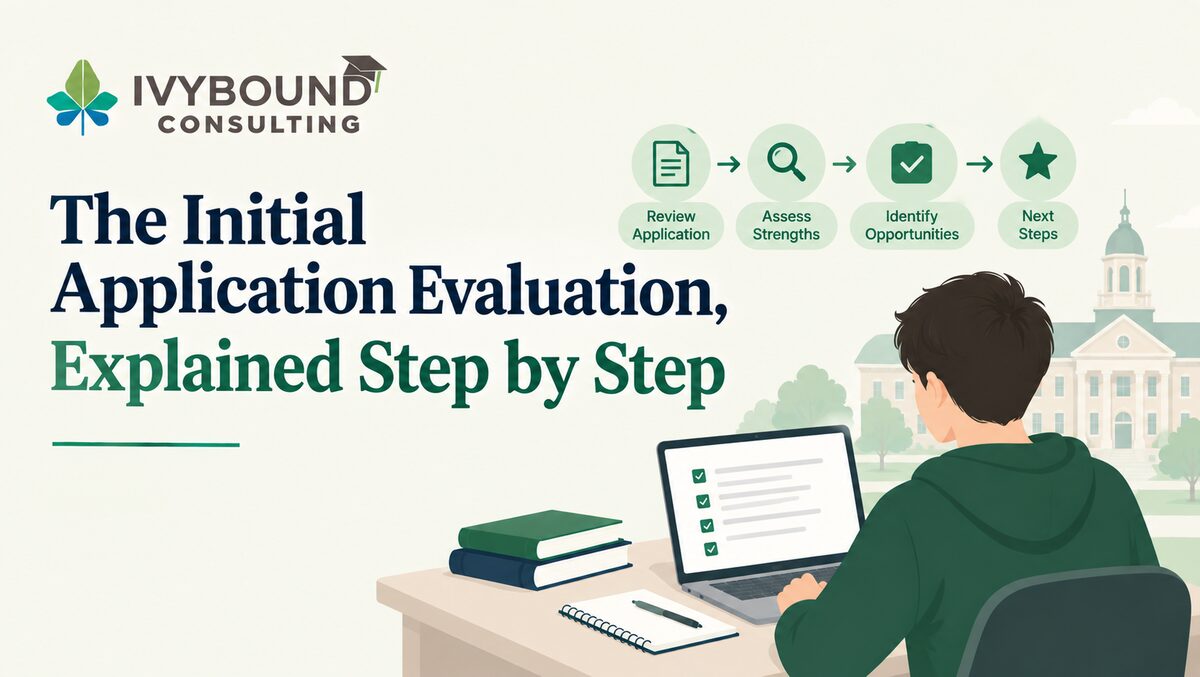
Submitting a college application can easily feel like casting a message in a bottle out into a vast, mysterious ocean where you have zero control over who finds it or what they think. High school seniors pour months of hard work into crafting their transcripts, personal essays, and activity lists, yet very few families understand the mechanical reality of what happens behind closed doors once that digital portal closes. At IvyBound Consulting, we believe that pulling back the curtain on the admissions office workflow is one of the most empowering things a student can do before hitting submit. When you know precisely how an admissions officer opens, breaks down, and scores your file during that initial evaluation window, you stop writing for an abstract committee and start writing for the exact person sitting at the desk. Demystifying this process eliminates the panic of the unknown and allows you to structure every single page of your application to survive the fast-paced reality of an initial review.
The Regional File Opening and Academic Gatekeeping Check
The very first step of the evaluation journey begins with your assigned regional admissions officer, who is responsible for managing all applications coming from your specific geographic territory or high school. Because these professionals handle thousands of files every single cycle, their initial assessment moves at a remarkably rapid pace, often lasting less than ten minutes total per applicant. They start by pulling up the school profile to understand your high school environment, grading scale, and the availability of advanced courses before diving straight into your academic record. Within the first ninety seconds, the reader evaluates your cumulative grade point average, course rigor, and standardized test scores if applicable, calculating whether you meet the foundational institutional threshold for academic success.
If an applicant lacks the necessary academic preparation or fails to handle the most rigorous classes available in their specific educational setting, the reader may quickly assign a lower academic rating that is very difficult to overcome later. However, if your transcript demonstrates that you can comfortably handle the intellectual demands of the university, your file immediately graduates to the qualitative review phase where your personal narrative begins to take center stage.
The Narrative Deep Dive Through Essays and Extracurriculars
Once your academic foundation clears the initial gatekeeping check, the regional reader transitions from quantitative metrics to qualitative storytelling by examining your activities list, personal statement, and supplemental essays. This middle phase is where the reader looks past your grades to discover who you are as an individual, a community member, and a thinker. They will scan your activities list to see where you invest your discretionary time, searching for depth of commitment, authentic leadership, and a clear spike of genuine passion rather than a superficial checklist of random clubs.
Next, they read your main personal essay and school-specific supplements to evaluate your voice, self-awareness, maturity, and capacity for critical reflection. Every single paragraph is checked for authenticity, ensuring that your unique perspective shines through rather than sounding like a sterile, overly edited product of outside interference. During this multi-minute deep dive, the admissions officer is actively trying to imagine you walking across their campus, asking themselves whether your presence will enrich seminar discussions, enliven residential halls, and contribute positively to the broader student body.
The Regional Advocacy and Internal Rating Assignment
The final step of the initial evaluation involves synthesizing all elements of your file into formal institutional ratings and preparing the case for the broader committee review. As the reader wraps up their review of your teacher recommendations and counselor evaluation which provide third-party validation of your classroom character, they assign numerical scores for your academic performance, personal qualities, and extracurricular impact. At selective institutions, the regional officer acts as your very first internal advocate, summarizing your file's strengths and weaknesses for colleagues who have not yet seen your work. Depending on the strength of these scores and the competitiveness of the applicant pool, your file will either be slotted into a preliminary acceptance bucket, flagged for a thorough debate during committee sessions, or marked for denial. Understanding that your regional reader is actively hunting for reasons to champion your candidacy transforms how you approach your writing, prompting you to build a cohesive, transparent, and compelling narrative from start to finish.
If you want to ensure your college application is strategically engineered to captivate regional readers and survive the rigorous initial evaluation process with flying colors, we are here to help. Contact IvyBound Consulting today to schedule a comprehensive application review with our expert advisors who will help you polish every single page of your profile for maximum admissions impact.
Schedule a free consultation with IvyBound Consulting to meet Ruchi S. Kothari, and take the first step toward a future that reflects who you truly are. Let’s talk!