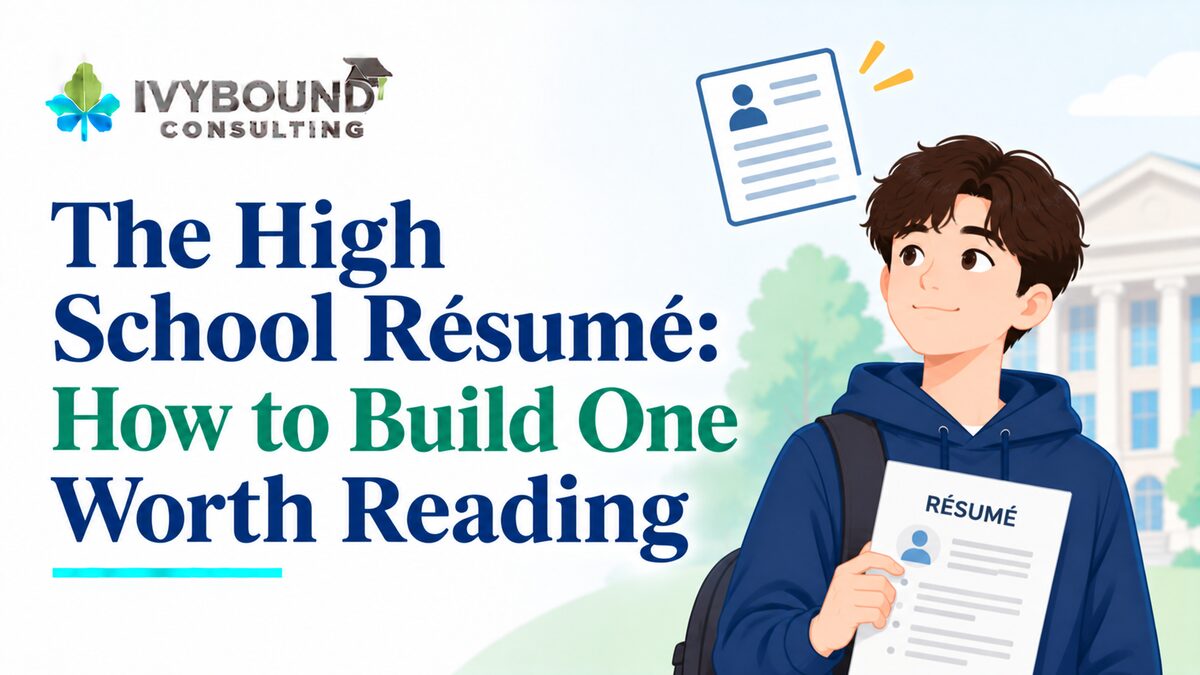
The High School Résumé: How to Build One Worth Reading
Crafting a compelling high school résumé is one of the most overlooked yet strategic tasks in the college admissions journey. While many students assume that their Common App activities section covers everything an admissions officer needs to see, a polished résumé serves as an indispensable master document for scholarship committees, internship coordinators, alumni interviewers, and teachers writing letters of recommendation. At IvyBound Consulting, we frequently review student résumés that read like dry, monotonous rosters of passive club memberships rather than dynamic records of genuine initiative and growth. Admissions readers spend mere minutes evaluating each candidate, meaning your résumé must immediately communicate focus, progression, and tangible outcomes without forcing the reader to decipher vague descriptions. Building a document truly worth reading requires shifting your mindset from simply listing where you showed up to demonstrating what actually changed because you were there. When approached thoughtfully, your résumé becomes a sharp narrative tool that ties together your intellectual curiosity, community engagement, and personal work ethic into one cohesive portrait.
Shifting from Passive Participation to Quantifiable Impact
The fastest way to lose an admissions officer's attention is to fill your résumé with generic job descriptions that explain what a club does rather than what you personally accomplished within it. Writing that you attended weekly meetings for the environmental club or helped organize a charity bake sale tells the reader nothing about your actual contribution or work ethic. Instead, every entry on your résumé should be anchored by strong action verbs and concrete, quantifiable metrics that illustrate the scale of your effort. Rather than stating that you tutored younger students, specify that you designed individualized weekly math curricula for twelve middle schoolers, resulting in an average grade improvement of one full letter across two semesters. Numbers, frequencies, funds raised, people reached, and hours committed provide immediate credibility and allow busy readers to grasp the weight of your involvement in seconds. Even if you do not hold a formal presidential title, highlighting moments where you identified a problem, proposed a solution, and executed an improvement demonstrates the exact kind of grassroots leadership that selective colleges actively seek.
Curating Depth and Cohesion Over Exhaustive Lists
A common misconception among ambitious teenagers is that a longer résumé automatically equals a more impressive candidacy, leading many students to cram every minor workshop, one-day volunteer shift, and freshman-year hobby onto two crowded pages. In reality, an unfocused laundry list dilutes your strongest achievements and suggests that you spread yourself too thin without committing deeply to anything. A truly standout high school résumé fits cleanly onto a single page and curates your experiences around two or three core thematic pillars that reflect your authentic interests. Grouping your activities into strategic categories such as academic research, community service, athletic leadership, or paid employment helps the reader immediately recognize the overarching narrative of your high school years. Showing multi-year progression within a handful of meaningful commitments is infinitely more persuasive than listing ten disconnected clubs joined during junior year. By ruthlessly editing out low-impact fillers, you create visual breathing room on the page and ensure that your highest-leverage accomplishments command the spotlight they deserve.
Formatting for Instant Readability and Strategic Versatility
Even the most extraordinary accomplishments will fall flat if they are buried inside dense blocks of text, inconsistent fonts, or cluttered graphic templates. Admissions officers, scholarship reviewers, and hiring managers overwhelmingly prefer clean, traditional formatting with clear typographic hierarchy, generous margins, and consistent alignment. Stick to classic, legible fonts, keep formatting minimalist without distracting sidebars or headshot photos, and organize each section in reverse chronological order so your most recent and mature achievements appear first. Beyond its use in college portals that allow supplemental uploads, this master résumé becomes your greatest asset when requesting letters of recommendation from teachers and school counselors. Providing your recommenders with a concise, well-organized summary of your out-of-classroom projects, summer programs, and personal milestones equips them with specific anecdotes to weave into their evaluations. Keeping this living document updated at the end of every semester ensures that you never scramble to recall details during senior fall and leaves you permanently prepared for unexpected internship or scholarship opportunities.
If you want expert guidance to transform your scattered activities into a crisp, persuasive high school résumé that captures the attention of admissions officers and scholarship committees, our team is ready to help. Contact IvyBound Consulting today to schedule a one-on-one résumé review and strategic profile session so you can present your achievements with clarity, confidence, and maximum impact.
Schedule a free consultation with IvyBound Consulting to meet Ruchi S. Kothari, and take the first step toward a future that reflects who you truly are. Let’s talk!